Alumnus Sam Buttler to premiere new work at 2026 Llangollen International Musical Eisteddfod
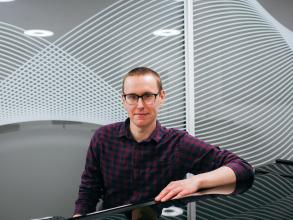
Image credit © Marissa DengMarissa Deng
Sam Buttler (St Peter's College, 2014) has been selected to compose a new work for the 2026 Llangollen International Musical Eisteddfod, where it will receive its world premiere as part of the festival's opening concert.
The commission forms part of Harmony Without Borders, a new initiative inviting early-career composers born, living, or studying in Wales to apply for a £6,000 paid commission, supported by the Arts Council of Wales, to create a six-minute bilingual work for choir and orchestra. Sam's piece, currently titled Greeting the Dawn, will be premiered on Tuesday 7 July as part of the festival's flagship opening concert, Uniting Nations: One World. The concert will also feature Sir Karl Jenkins conducting his work One World.
Originally from Cardiff, Sam was selected by a panel including Brian Hughes, Anthony Gabrielle and Tori Longdon. In 2024 he received the Paul Mealor Award for Young Composers from the Welsh Music Guild. He took part in the 2025 Composers Academy at the Cheltenham Festival, writing a new work for George Parris and The Carice Singers, and was a member of the 2024 JAM on the Marsh Composer's Residency, where he wrote an opera based on the films of Derek Jarman with a libretto by Grahame Davies. In 2024 he released his debut EP with Ensemble Matters, To the Waters and the Wild…, and in 2023 he was selected for the Peter Reynolds Composers Studio at the Vale of Glamorgan Festival. He was also one of six composers selected for Tŷ Cerdd's CoDI Lead scheme, working with musicians from Paraorchestra on Chariots, Death, Jewels, and the Moon, premiered in 2022. The same year, his work Stones Have Memory Here was featured as BBC NOW Composition: Wales.
Sam studied Music at St Peter's College where he was a choral scholar, graduating in 2017. He later completed a Master's in Composition at Royal Holloway and is currently completing a PhD in Music Composition at King's College London.
Speaking about the commission, Sam said:
It means the world. I've never had an opportunity on this scale and to not only open the festival, but to have my music alongside Sir Karl Jenkins's - another Welsh oboist and composer - is something I don't think I could have ever imagined. It means so much that my music will open the Eisteddfod, as so often the 'new music' is not given such a prominent spot. I can't thank everyone involved enough. I'm still slightly in shock. Wales has such an incredible musical culture, and especially some brilliant composers. It's easy to feel like no-one is hearing your musical voice, so to be selected from such a strong field is amazing. The spirit of the Llangollen International Musical Eisteddfod also really appealed to me. Music has the power to bring people together and can be a real force for good.
'Everyday Beethoven' - Professor Laura Tunbridge