
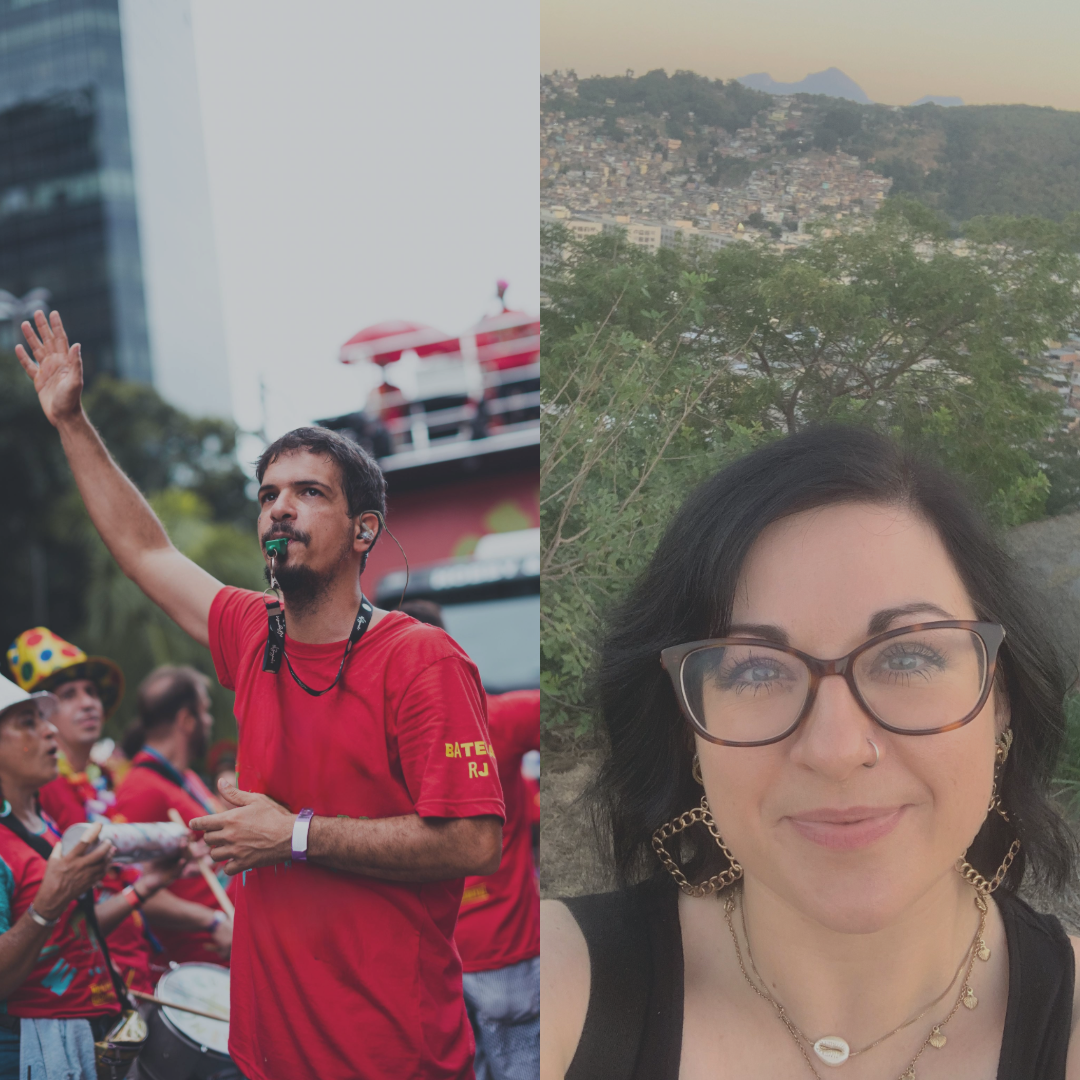
Public seminar: Gabriel Lopes & Gabrielle Messeder (University of Oxford)
Free entry, no registration required
'Listening to the Archive: What Samba School Recordings Reveal, and Conceal'
Abstract
The samba school bateria - the percussion ensemble at the heart of Rio de Janeiro's carnival parade - is one of the most complex and powerful collective musical traditions of the twentieth century. Comprising up to 300 musicians playing entirely without melody instruments, the bateria is the engine of the samba school parade, driving dancers, floats, and singers through a sophisticated arrangement vocabulary built around groove, rhythmic variation, signal calls, and breaks.
The samba school itself is a community organization rooted historically in the Black neighborhoods of Rio de Janeiro. Created in the late 1920s, samba schools grew from the poor periphery of the city and carried with them the cultural memory and resilience of those communities. At a certain point, the Brazilian government deliberately adopted samba and the samba schools as symbols of national identity, a nationalist political project, most prominently during the Vargas era in the 1930s and 1940s, that reframed a Black community tradition as the soul of the nation. That political appropriation, and the irony embedded in it, remains central to understanding what the samba school represents in Brazilian culture today.
The bateria sits at the core of this tradition. It is entirely percussion (no melody, no harmony in the conventional sense) yet it supports and drives every other element of the parade. Its arrangement language is built from four elements: the groove, the continuous rhythmic foundation; the turn, a short collective variation used to mark transitions; the repique call, a signal that starts or returns the groove; and the break, the moment where the entire ensemble stops simultaneously and re-enters together, one of the most viscerally powerful moments in live carnival performance.
This lecture explores the bateria as a musical tradition, traces its historical development, and asks what seven decades of carnival recordings can, and cannot, tell us about how it became what it is today.
Biography
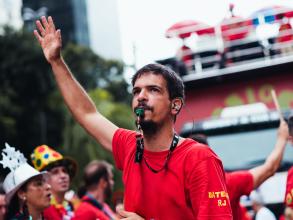
Gabriel Lopes has been a prominent figure in Brazilian music and Rio's Carnival culture since the early 2000s. Combining his roles as a seasoned musician, educator, and researcher, Gabriel has dedicated his career to preserving, teaching, and celebrating the rich traditions of samba school baterias.
Gabriel's deep expertise as an educator is exemplified by his work with prestigious music institutions such as the Royal College of Music and the Royal Birmingham Conservatoire, where he led workshops in 2019, 2023, and 2024. In 2023, he brought his unique approach to the Conservatorium van Amsterdam, and in 2024, he conducted workshops at Trinity School in Croydon. His ability to engage and inspire students, coupled with his extensive experience in high-profile educational settings, underscores his standing as a respected authority in Brazilian percussion.
As a researcher and author, Gabriel has made significant contributions to the understanding of samba and samba school baterias. His published works include Mestre Dudu - As Paradinhas da Não Existe Mais Quente, As Bossas do Mestre Maurão, and Fundamentals of a Samba School Bateria. These bilingual books not only document the evolution of samba rhythms but also provide practical tools for musicians worldwide, featuring audio examples and musical notation for paradinhas and bossas. Through these publications, Gabriel preserves the legacy of samba school drumming while making it accessible to a global audience.
As a performer, Gabriel has toured extensively with the renowned percussion group Monobloco, captivating audiences across Brazil, the USA, Europe, and Japan. His dynamic performances and integral contributions to Monobloco's sound have solidified his reputation as a leading figure in the global samba scene. With Monobloco, he recorded two albums and two DVDs, contributing to the group's dynamic legacy.
Gabriel also played in Rocinha's bateria for over a decade and has been a member of Vila Isabel's bateria since 2019, specializing in the repique drum. As a composer, he achieved a career milestone by entering his samba composition into Mangueira's competition in 2016. From 2005 to 2019, Gabriel served as the mestre de bateria for Volta Alice, a carnival group (bloco) that became a cornerstone of Rio Carnival, attracting tens of thousands of revelers.
He has also taught at Monobloco's workshops, preparing students for parades in Rio de Janeiro, Belo Horizonte, and São Paulo. His teaching extends internationally, with workshops held across the UK, Europe, the USA, Japan, Korea, and Taiwan, both in-person and online. Through his brand, Samba Beats, Gabriel continues to share his passion for samba school baterias. His website, YouTube channel, and social media platforms provide a wealth of educational content, including tutorials, historical insights, and detailed analyses of samba rhythms. His dedication to teaching and research reflects his mission to preserve and celebrate the cultural and musical heritage of Brazil.
Gabriel Lopes offers an unparalleled blend of practical expertise, academic research, and teaching excellence. His work not only connects audiences to the vibrant world of samba but also inspires the next generation of percussionists worldwide.
'Commemorating the Sambista Perfeito: Arlindo Cruz's funeral in Madureira, Rio de Janeiro'
Abstract
This talk examines the local, emotional and spiritual significance of the roda de samba (samba circle) in Rio de Janeiro's northern suburbs through the life, music, and funeral of the celebrated sambista Arlindo Cruz. Drawing on ethnographic fieldwork conducted in Rio, it situates Cruz as a paradigmatic figure whose oeuvre speaks to the aesthetics, values, and lived experiences of the subúrbio. Central to the discussion is the public all-night celebratory vigil (gurufim) held at the Império Serrano samba school in Madureira following Cruz's death in August 2025. Here, as his body lay in state, a roda de samba played for hours in celebration of his life and to ease his passing into the next realm. I will discuss how one of the songs played throughout the night, Cruz's composition O Meu Lugar ('My Place'), articulates themes of place and local community, Afro-Brazilian religious practices and saudade (bittersweet sadness or longing).
Read through Afro-Brazilian religious cosmologies and situated within broader Afro-Atlantic commemorative rituals, the gurufim, the roda, and the collective singing of Cruz's repertoire position his death as a transition through which he becomes an ancestral sambista: one who can be invoked through song and whose canonical musical presence is sustained as part of samba's evolving, living heritage. Finally, I seek to contribute to broader debates on affect, positionality, and the role of emotion in ethnographic knowledge production by briefly reflecting on my own affective response to Cruz's gurufim, arguing that emotional resonance and personal grief are not incidental but central to understanding the roda as a therapeutic, embodied, and relational practice.
Biography
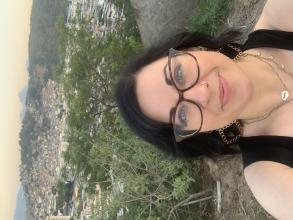
Dr Gabrielle Messeder is a Fitzjames Early Career Researcher in Music at Merton College, University of Oxford. Gabrielle completed her doctoral research on Brazilian music and dance in Lebanon at City in 2023, supervised by Professor Laudan Nooshin. Her current research project at Merton examines the social, economic, and creative importance of rodas de samba in Rio de Janeiro, Brazil. Previously, Gabrielle was visiting lecturer in Music at Goldsmiths and City, University of London, and was a Research Fellow at the University of Greenwich on the AHRC-funded project 'Exploring cultural diversity in experimental sound' (2021-23).