Public seminar: Gregory Camp (University of Auckland)
'Musical Nostalgia, Frisson, and Canon Formation in Disney Theme Park Shows'
Free entry, no registration required
Abstract
The Disney theme parks are known among the fan community for their careful attention to musical detail, but academics have only recently begun to examine the inner workings of theme park music. The Disney company has created a canon of its own music, wrapped up in multi-generational feelings of nostalgia, and the various musical shows presented in the parks are important sites for the formation of this canon. One such nostalgia-inducing show is the Country Bear Jamboree, a 20-minute audio-animatronic musical starring a group of singing bears, which has been playing at Walt Disney World since 1974. A 2024 re-theme, re-titled the Country Bear Musical Jamboree, replaces most of the original music with a panoply of Disney songs in country arrangements. This new version is centred not around the historicised nostalgia for vaudeville and music hall but around the nostalgia guests feel for classic (and new) Disney songs themselves, compounded with their nostalgia for the original show. The bears and their automated musical serve as markers for the middle ground between nostalgia, pastiche, and canon formation. Another type of show, the fireworks spectaculars that are presented in many of the Disney parks, also uses new and classic Disney songs to reinforce the existence of the canon and to generate nostalgic frisson through cohesively structured musical narratives. The Magic Kingdom’s current fireworks show Happily Ever After is indicative in that it includes 24 songs in its 18 minutes, ranging from full choruses heard in their original film versions to single phrases newly arranged or combined with other songs, all stitched together with dramatic modulatory progressions borrowed from contemporary film scoring practices. Far from being merely Disney song highlights reels, these theme park shows are carefully crafted mini-musicals that highlight the centrality of music to Disney’s identity.
Biography
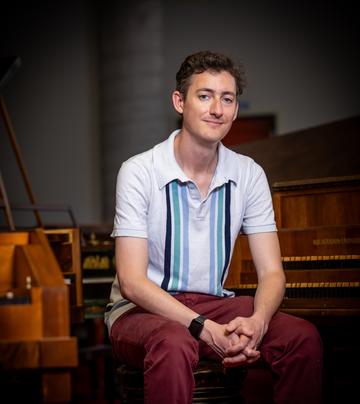
Dr Gregory Camp is a Senior Lecturer in Music and Associate Head Teaching and Learning in the University of Auckland School of Creative Arts, where he teaches a wide variety of topics in musicology and music theory. He is also the artistic director of the University of Auckland Opera Workshop, for which he directs a production each year. His doctoral research, undertaken at the Queen’s College, Oxford, was on the modern performance history of the operas of Claudio Monteverdi. He has published two monographs with Routledge on mid-twentieth century film music: Howard Hawks: Sonic Style in Film (2020) and Scoring the Hollywood Actor in the 1950s (2021), and chapters on Disney choral arrangements, community singing in Disney texts, and the aesthetics of the Disney Channel Original Musical corpus. His most recent books are Linguistics for Singers (Routledge, 2023), a manual that guides musicians through the poetic texts they work with via a holistic and comparative approach, and Music in the Disney Parks (Routledge, 2026), the first monograph on theme park music. Current work includes an anthology of opera libretto translations under contract with Oxford University Press and further work on Disney music. A long-time choral singer, he sings regularly with the Auckland Chamber Choir and Voices New Zealand.

