

"Speaks" with Matmos
Free to attend, register via this online form. After 10am on the day of the event, please email Danny at events@music.ox.ac.uk for the Zoom link.
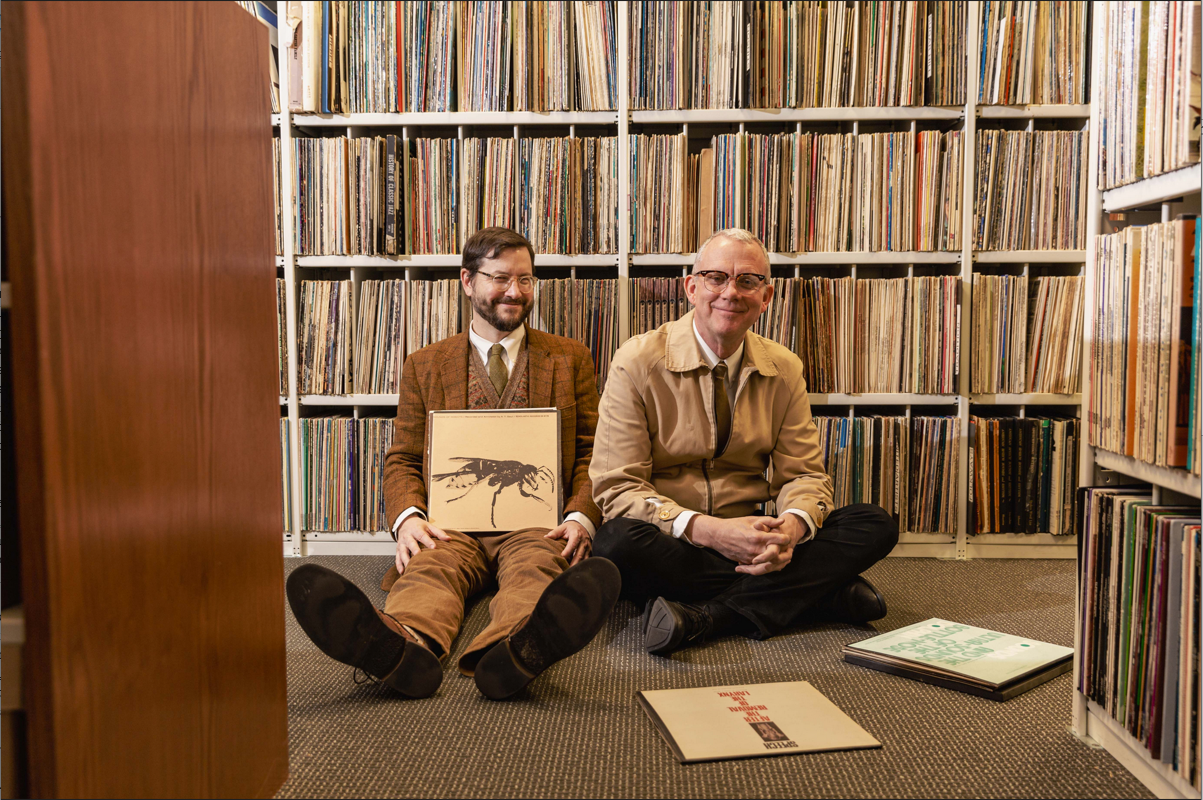
Based in Baltimore, Matmos is Drew Daniel and M.C. Schmidt. The two have been making music as Matmos since 1997, first in San Francisco, and then relocating to Baltimore in 2007 when Daniel began to teach at Johns Hopkins University. They are respected, innovative auteurs in the world of electronic music and sampling culture whose very first album was hailed as "entering electronics Valhalla" by the WIRE magazine for sampling highly unusual sound sources such as the amplified nerve tissue of crayfish. Ever since, they have made music out a wildly heterogeneous set of objects and sources, including the sound of the pages of bibles turning, water hitting copper plates, liposuction surgery, cameras and VCRs, chin implant surgery, contact microphones on human hair, rat cages, tanks of helium, a cow uterus, human skulls, snails, cigarettes, cards shuffling, laser eye surgery, whoopee cushions, balloons, latex fetish clothing, rhinestones, Polish trains, insects, life support systems, inflatable blankets, rock salt, solid gold coins, the sound of a frozen stream thawing in the sun, a five gallon bucket of oatmeal, snails interrupting the path of a laser and altering the pitch of a light sensitive theremin, a PVC police riot shield, silicon breast implants, and their own washing machine. These raw materials are manipulated into surprisingly accessible forms, and often supplemented by traditional musical instruments played by internationally celebrated guest musicians from their circle of friends and collaborators. The result is a model of electronic composition as a relational network that connects sources and outcomes together; information about the process of creation activates the listening experience, providing the listener with entry points into sometimes densely allusive, baroque recordings that have the direct sensory immediacy of pop music.
Matmos have collaborated with a wide array of artists across media and distinct disciplines. A partial list of musical collaborators includes: Bjork, The Kronos Quartet, Terry Riley, Marshall Allan (Sun Ra Arkestra), So Percussion, Anohni, Yo La Tengo, The Rachel's, Oneohtrix Point Never, Jefferson Friedman, Zeena Parkins, J.G. Thirlwell, Jeff Carey, Wobbly, David Tibet, and Mouse On Mars. The diversity of this list, comprising internationally celebrated pop stars, minimalist composers, giants of jazz and indie rock and innovative improvisers and electronic musicians, indicates the range across genres and musical scenes that has been the hallmark of Matmos' varied and mercurial career. Matmos have made musical soundtracks to films by acclaimed filmmakers such as Daria Martin and John Cameron Mitchell (on "How to Talk to Girls at Parties", written by Neil Gaiman and starring Nicole Kidman and Elle Fanning). Matmos has collaborated with theatrical directors such as Young Jean Lee (on "The Appeal" and "We're All Gonna Die") and Robert Wilson (on "The Life and Death of Marina Abramovic", starring Willem Dafoe, Anohni, and Marina Abramovic). The band has released over twelve albums, and numerous EPs for the labels Matador and Thrill Jockey. Matmos have been electronic music tutors at the distinguished and highly selective Darmstadt Ferienkurse, guest artists at the Ruskin School of Art at Oxford University, visiting faculty at Harvard University in the "Learning from Performers" series and presented our work at music departments such as Princeton, U.C. Berkeley, UVA, SciArc, Indiana University, and the San Francisco Art Institute. Matmos have performed all over the world, including key performances at Carnegie Hall, Zankel Hall, Walt Disney Hall, Orchard Hall in Tokyo, Santa Cecilia in Rome, MUTEK in Mexico City, Radio City Music Hall, the Sydney Festival in Sydney, Australia, and the Centres Georges Pompidou in Paris, and have had residencies at the INA/GRM in Paris, and at the Civitella Ranieri Foundation in Tuscany. Their most recent albums include "Regards / Uklony dla Boguslaw Schaeffer" (Thrill Jockey, 2022), a manipulation of the Polish electroacoustic composer's works, and "Return to Archive", a transformation of the nature, science and field recordings in the back catalog of the Folkways label (Smithsonian Folkways, 2023).
About the Series:
Professor Jennifer Walshe and Professor Martyn Harry convene this online series in which visiting composers discuss their work. Free and open to all.